Works Product & Engineering
Premium pay tied to commitment: the FTE attainment model
Why flat shift bonuses fail the workers who already show up, and how gating incentive pay on FTE attainment rewrites the signal.



Blog
Product thinking, engineering deep-dives, company announcements, and perspectives from the team building Trusted.
Why flat shift bonuses fail the workers who already show up, and how gating incentive pay on FTE attainment rewrites the signal.
Each week, fifty-plus vendor management systems send us invoice data in their own format. Here is the four-step pipeline, the identity bridge, and the derived state machine that collapses all of it into one reconciled ledger.
Calls, SMS, email, and in-app messages all belong on the clinician's record. The hard part isn't capture. It's figuring out who you were talking to.
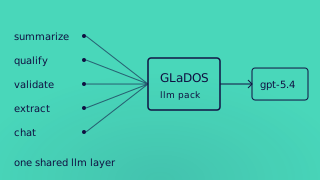
One shared pack runs every AI feature in our Rails app. Here's why building it once paid for the next ten features, and the pieces of GLaDOS that made that compounding possible.
A submission to a VMS isn't a form; it's an assembled document set. Here's how we encode every client's packet rules as data instead of code.
Reference collection was the last manual bottleneck in the clinician submission pipeline. Here's the small system of background jobs, two-channel notifications, and PDF generation that does most of the chasing for us.
Before autocuration, before AI, there's a data problem. A raw VMS job is not a job. Here's what it takes to turn a vendor snapshot into a postable shift.
Every travel-nursing job on Trusted starts as a raw payload from a vendor management system. Here is how we collapse 30+ vendors and three entry paths into one ingestion pipeline.
We had three different systems computing nurse pay packages. None of them kept a record of what they'd computed, or why. That's the kind of problem that compounds quietly until it doesn't.